Buy from a trader and the Consumer Rights Act 2015 stands behind you. Buy from a private seller and it does not apply at all. That single difference explains the price gap between a forecourt and a driveway, and it explains why a private purchase needs far more checking before any money moves.
Quick answer
From a trader
- The car must be of satisfactory quality, fit for purpose and as described.
- 30 days from delivery to reject a faulty car for a full refund.
- After 30 days, one repair or replacement, then a final right to reject.
- For six months, the dealer has to prove the fault was not there at sale.
- You pay more, because the dealer is pricing that risk in.
From a private seller
- The car must be as described, and the seller must have the right to sell it.
- No satisfactory quality duty, no fitness for purpose duty.
- No right to reject, no repair route, no cooling off period.
- A fault you could have found by looking is now yours.
- You pay less, because you are carrying the risk yourself.
What the Consumer Rights Act gives you at a dealer
The Act applies whenever a business sells to a consumer, so it covers franchised dealers, independent forecourts, online retailers and anyone trading in cars as a business, even from a driveway. Three standards apply to the car.
- Satisfactory quality, judged against the car's age, mileage, price and description, not against a new car.
- Fit for purpose, including any specific purpose you told the dealer about, such as towing.
- As described, which takes in the advert, the spec sheet and what the salesperson said.
Fail any of those and you have 30 days from taking delivery to reject the car and ask for a full refund. After 30 days you move to the next stage, where the dealer gets one attempt at a repair or a replacement. If that attempt fails you can still reject, although the refund can be reduced to reflect the use you have had.
The most valuable part is the burden of proof. For the first six months, a fault that appears is treated as having been present at sale unless the dealer proves otherwise. After six months that flips, and you are the one paying for an independent report.
Satisfactory quality is not a warranty against everything. A twelve year old car with 130,000 miles is allowed tired suspension and a worn clutch. The test is what a reasonable person would expect at that age, mileage and price, so the bar sits far higher on an approved used car sold at a premium.
Rejection is an act, not a conversation
If you need to reject a car, email the dealer the same day. Say plainly that you are rejecting it under the Consumer Rights Act 2015, describe the fault and give the date and mileage. A phone call you cannot evidence is worth very little three months later.
What a private seller actually owes you
Two things, and no more.
First, the seller must have the right to sell the car. If it is still on hire purchase or recorded as stolen, they do not own it outright and cannot pass good title to you.
Second, the car must be as described. If the advert claims full service history, one former keeper or no accident damage and that is untrue, you have a misrepresentation claim. What you do not get is any duty of quality. If the gearbox goes on the way home and the seller never mentioned the gearbox, there is no route at all.
Why private cars are cheaper
The gap is not generosity. A dealer pays for preparation, a fresh MOT and service, tyres, a valet, a warranty, premises, staff and the cost of being on the hook for six months. All of that sits in the screen price. A private seller carries none of it.
So a private purchase is really a decision to buy the risk a dealer would otherwise price in. That is a sound trade, but only if you do the checking the dealer would have done first.
Why a history check matters more privately
Outstanding hire purchase is the sharpest example. Until the agreement is settled the finance company owns the car, and it can be recovered from you even though you paid the seller in full. Private buyers do have a protection in law where they bought in good faith with no knowledge of the agreement, but relying on it means arguing your case after the car has been taken away. A car finance check beforehand is a great deal cheaper than that argument.
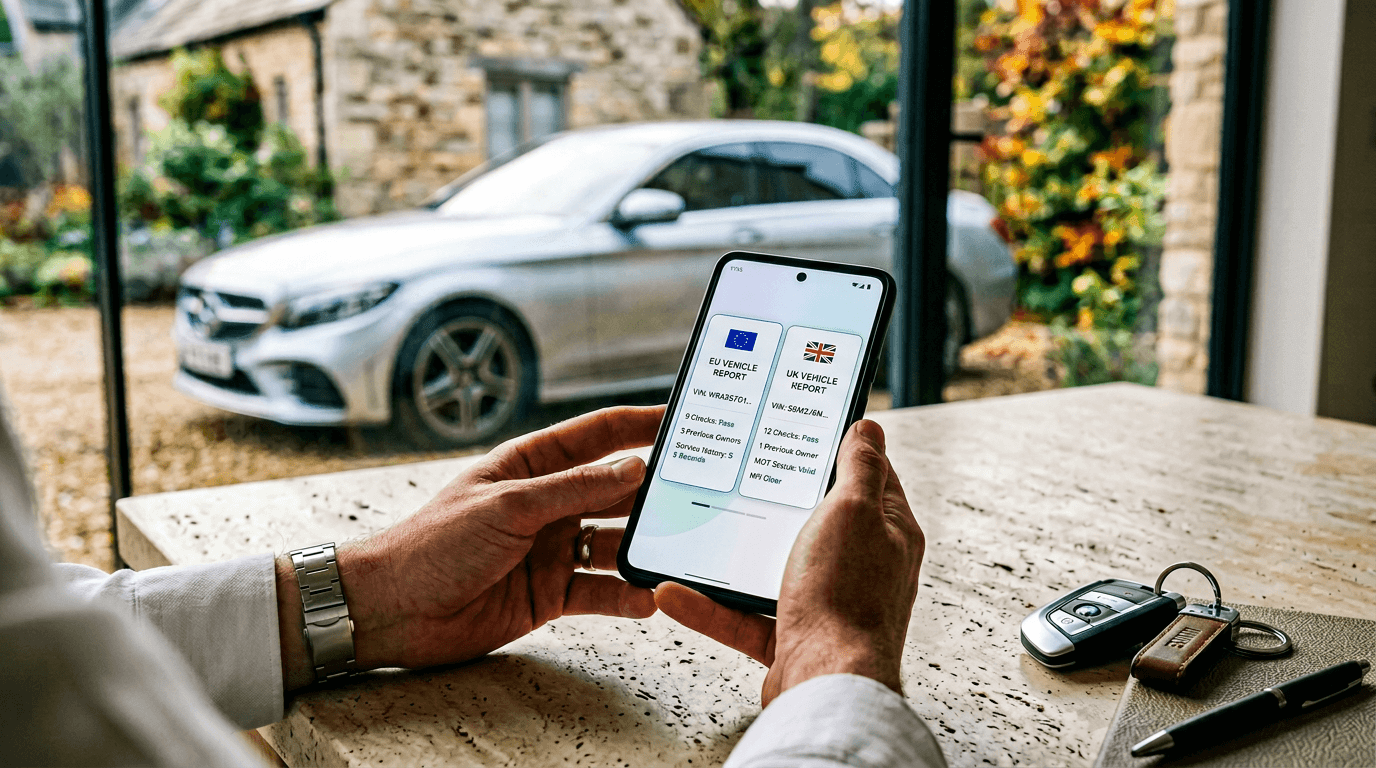
The same logic runs through the rest of it. A write-off marker shows the car was once an insurance total loss even where the repair looks tidy. A mileage check against the reading taken at every MOT catches a clock that has gone backwards. A full used car check pulls finance, write-off and stolen markers, mileage, MOT history and keeper history together for £15, which is close to the due diligence a dealer would have run before putting the same car on a forecourt.
How to buy privately without getting burned
Most private sales are ordinary and go fine. The ones that are not tend to announce themselves early, and the usual red flags are easy to spot once you know them.
- View at the address printed on the V5C, in daylight, on a cold engine. Never a car park or a lay-by.
- Check the seller's name is the registered keeper on the V5C, and ask why if it is not.
- Match the VIN on the car to the VIN on the V5C and to the check you ran.
- Screenshot the advert and keep the messages. That text is the description, and your only claim rests on it.
- Pay by bank transfer to an account in the seller's name. Avoid cash handovers away from the property.
- Write a receipt with both names and addresses, the registration, VIN, mileage, date, price and the words used to describe the car.
Two things no history check covers, so handle them separately. Outstanding safety recalls are free to look up on GOV.UK, and whether a car is currently insured is not part of any vehicle history report.
If a dealer sold you a faulty car
- Stop driving it if the fault is safety related, and note the mileage.
- Email the dealer that day. Describe the fault and, inside 30 days, state that you are exercising the short-term right to reject.
- Give a clear deadline in writing for their response.
- If you paid any part of the price by credit card, and the price was over £100 and up to £30,000, your card provider is jointly liable with the dealer under section 75 of the Consumer Credit Act 1974.
- If the car was bought on finance, complain to the finance company, then the Financial Ombudsman Service. If the dealer belongs to a motor industry ombudsman scheme, use it.
- The small claims track is the backstop, and the written record from step two is usually what decides it.
If a private seller misdescribed the car
Your claim is misrepresentation or breach of contract, not consumer law. You have to show what was said, that it was untrue, and that you relied on it when you bought. That is why the advert screenshots and the receipt wording matter so much, and why a vague description helps the seller. Claims of this size go through the small claims track, which is designed to be used without a solicitor. The hard part is rarely winning. It is getting paid by someone who has spent the money.
Key takeaways
- Trader sales carry the Consumer Rights Act 2015: satisfactory quality, fit for purpose, as described, with 30 days to reject.
- Private sales carry two duties only. The car must be as described, and the seller must have the right to sell it.
- Private prices are lower because you are taking on the risk a dealer would otherwise price into the car.
- Advert screenshots and a detailed written receipt are the evidence a private claim stands or falls on.
- Check finance, write-off, stolen markers and mileage before you pay privately, because there is no comeback afterwards.