You have found a used car that looks like a great deal. The photos are clean, the price is tempting, and the seller seems keen. But something at the back of your mind is nagging you: what if this car has a hidden past? One of the most serious things a car can carry is a scrapped marker, and it is exactly the kind of problem that does not show up on a test drive.
This guide explains how to check if a car has been scrapped before you pay, what a scrapped status actually means, what the DVLA can and cannot show you, and why some scrapped cars still turn up for sale. If something does not add up, you will know how to spot it.
Quick Answer
To check if a car has been scrapped, run a car history check using the registration. It will flag a scrapped or destroyed marker recorded against the vehicle, alongside other risks like outstanding finance, write-offs and mileage problems. The free DVLA vehicle enquiry can show tax and MOT status, but it does not show whether a car has been scrapped.
A scrapped car is meant to be gone for good. If a vehicle carries a scrapped marker and is still being advertised, treat it as a serious warning and do not hand over any money until you understand why.
What Is a Scrapped Vehicle?
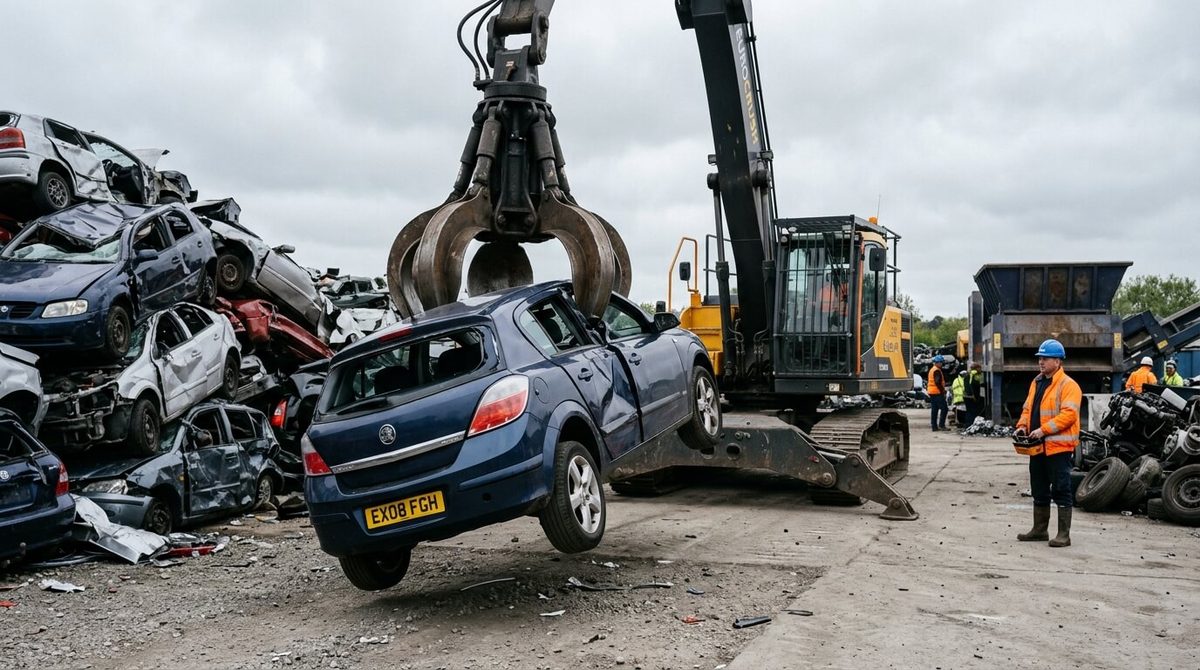
A scrapped vehicle is one that has been taken to an Authorised Treatment Facility, which is a licensed scrapyard, and recorded as destroyed. When that happens, the facility issues a Certificate of Destruction and notifies the DVLA, and the vehicle's registration is permanently retired.
From that point on, the car should never legally be taxed, insured or driven on the road again. This is different from a car that is simply old, sitting off the road, or even written off. A scrapped record means the vehicle has officially reached the end of its life and is not supposed to exist as a roadworthy car anymore.
That is why a scrapped marker is so serious. It is not a minor blemish on the history. It is a signal that the car in front of you may not be what the seller is claiming.
How to Check if a Car Has Been Scrapped
There are three practical ways to check, and they are not equally reliable. Used together, they give you a clear picture.
- Run a vehicle history check. The most reliable method. It surfaces a scrapped or destroyed marker recorded against the registration, plus other hidden risks.
- Use the DVLA vehicle enquiry. A free official tool that shows tax and MOT status and basic vehicle details. Useful, but limited for spotting a scrapped car.
- Look at the MOT history. A car that has been scrapped will usually stop appearing in new MOT records. Helpful as a clue, but not proof on its own.
The rest of this guide walks through each of these so you know what they can and cannot tell you.
Check the Vehicle History
A vehicle history check is the clearest way to find out if a car has been scrapped. Enter the registration and the check looks the car up against official and industry records, then tells you whether a scrapped or destroyed marker is recorded.
The advantage is that it does not rely on the seller being honest, and it does not stop at the scrapped question. A single registration can hide several problems at once. A proper reg check brings them together so you are not piecing the story together yourself:
- Scrapped or destroyed status: whether the car is recorded as having reached the end of its life.
- Write-off history: insurance write-off categories that affect safety and value.
- Outstanding finance: money still owed that can pass to you with the car, which a finance check reveals.
- Stolen markers: whether the vehicle has been reported and recorded stolen.
- Mileage discrepancies: readings that drop or jump, which a mileage check highlights.
If you only do one thing before paying, this is it. A scrapped marker is the kind of problem that is far cheaper to find now than to discover after the money has gone.
Check the DVLA Vehicle Enquiry
The DVLA offers a free vehicle enquiry on GOV.UK that anyone can use with the registration. It is a sensible second source, but it is important to understand its limits before you lean on it.
What the DVLA vehicle enquiry can show:
- The make, colour, year of manufacture and engine size.
- Current tax status and when it expires.
- MOT status and expiry.
- Whether the vehicle has been declared off the road with a SORN.
What the DVLA vehicle enquiry cannot show:
- Whether the car has been scrapped, or any scrapped marker written in plain language for buyers.
- The Certificate of Destruction itself, or who scrapped the car.
- Outstanding finance, write-off categories or stolen markers.
- Mileage discrepancies across the car's life.
A scrapped car will often look untaxed with no valid MOT, and the basic details may not line up with the car you are looking at. Those are useful signals, but absence of tax and MOT is not the same as confirmation. For a clearer view of the official record, a free DVLA vehicle check is a good starting point, and it pairs well with a full history check.
Why MOT and Tax History Are Useful but Incomplete
The free GOV.UK MOT and tax history records are genuinely worth a look. The MOT history shows past test results, advisories and recorded mileage, which is great for spotting clocking and neglect. The tax history tells you whether the car has been kept legal and on the road.
The catch is that these records show activity, not the absence of it. A scrapped car simply stops generating new MOT and tax records. A sudden, unexplained stop can be a clue, but a long-off-the-road car can look similar without being scrapped. That is why MOT and tax history work best as supporting evidence rather than the final word.
Check for a Certificate of Destruction
A Certificate of Destruction is the legal proof that a vehicle has been scrapped. Only an Authorised Treatment Facility can issue one, and once it is issued and the DVLA is notified, the car cannot be taxed or driven again. It is the document that formally ends the vehicle's life on the road.
As a buyer, you will not usually be handed a Certificate of Destruction, because an honest seller of a roadworthy car has no reason to have one. What matters is the record behind it. If a scrapped marker appears against a car that is being sold to you as a normal used vehicle, the seller's story and the official record are in direct conflict, and that conflict should stop the sale.
Scrapped vs Written Off vs SORN vs Exported
These four terms get mixed up constantly, and the differences matter. Only one of them means the car should never return to the road.
| Status |
What it means |
Can it return to the road? |
| Scrapped |
Destroyed at a licensed facility, with a Certificate of Destruction issued and the registration retired. |
No. It is permanently off the road. |
| Written off |
Declared an insurance loss after damage, in categories A, B, S or N. |
Sometimes. Cat A and B must be destroyed; Cat S and N can be repaired and used again. |
| SORN |
Declared off the road by the owner, untaxed and kept on private land. |
Yes. It can be taxed and used again at any time. |
| Exported |
Permanently taken out of the UK, with the UK registration closed. |
Not in the UK. It is registered in another country. |
The key takeaway is that a SORN car or a repairable write-off can legitimately be back on the road, but a scrapped car cannot. If a seller uses these terms loosely, or describes a scrapped car as merely "off the road for a while", slow down and verify. A write-off check and a full history check will tell you which category, if any, actually applies.
How Scrapped Cars Can End Up for Sale
If a scrapped car should never return to the road, how do they sometimes appear in the used market? The honest answer is that almost always, something has gone wrong, and rarely in the buyer's favour.
- Cloning: a scrapped or stolen car is given the identity, plates and paperwork of a similar legitimate vehicle that still exists elsewhere.
- Illegal rebuilds: a car that was supposed to be destroyed is patched back together and sold, despite carrying a scrapped record.
- Reused parts and identities: components or documents from a scrapped car are used to disguise another vehicle's history.
- Genuine confusion: occasionally a record is wrong or out of date, but this is rare and still needs proper checking before you trust it.
So can a scrapped car go back on the road? Legally, no. Once a Certificate of Destruction is issued and the DVLA records the car as destroyed, the registration is retired for good and the vehicle cannot be taxed, insured or driven again. A car with a scrapped marker on sale is a reason to walk away, not to negotiate.
Has My Car Been Scrapped?
Sometimes the question is about your own car rather than one you are buying, especially if you sent a vehicle to be scrapped and want to confirm it was done properly. Loose ends here can leave you liable for tax or fines on a car you no longer have.
- Check the DVLA record. Use the GOV.UK vehicle enquiry with your registration to see the current status.
- Confirm you received a Certificate of Destruction. A licensed facility should send this to the last owner, usually within seven working days of scrapping.
- Chase the scrapyard if it has not arrived. If you have no certificate, contact the facility that took the car and ask them to confirm it was scrapped and notified to the DVLA.
- Tell the DVLA if anything is wrong. If the record still shows the car as yours and on the road, contact the DVLA so it can be corrected.
Getting that confirmation in writing protects you. Until the record shows the car as destroyed, you may still be treated as responsible for it.
What Happens if You Buy a Scrapped Car?
Buying a car that is recorded as scrapped is not a small administrative headache. It can cost you the car and your money at the same time.
- You may be unable to tax, insure or legally drive it, because the registration has been retired.
- The vehicle may be a clone, which means it could be seized and returned to the rightful owner or their insurer.
- Recovering your money from the seller can be very difficult, especially if they used false details.
- Even if it runs, you could be left with a car you cannot legally use or sell on.
A scrapped marker is a stop sign
If a car you are considering shows a scrapped or destroyed record, do not pay a deposit or transfer any money. There are always other cars. There is rarely a good reason for a genuinely scrapped vehicle to be on sale as a normal used car.
Warning Signs Before Buying
No single sign proves a car has been scrapped, but several together should make you stop and run a proper check.
- The price is noticeably lower than similar cars.
- The MOT history stops abruptly with no explanation.
- The seller is vague about the car's recent past or where it has been.
- The V5C logbook is missing, or said to be "in the post".
- The VIN on the car does not match the documents.
- The seller will not meet at the address on the V5C.
- You are being rushed to pay before you can check anything.
Many of these overlap with the wider red flags when buying a used car. If you spot a cluster of them, treat the car as guilty until the records prove otherwise.
Final Advice
A scrapped car is meant to be the end of the road, so finding one for sale is a clear sign that something is wrong. The good news is that you do not have to take the seller's word for anything. The records exist, and you can check them in a minute before you commit.
Start with the free tools to get your bearings, including a free car check and the GOV.UK MOT and tax history. Then, before you pay, run a full history check so a scrapped marker, finance, write-offs, stolen records and mileage problems are all in front of you while you still have the power to walk away.
Before you pay
Run a Carpeep
car history check by
registration before buying. It flags a scrapped or destroyed marker along with other serious risks, so a tempting car cannot hide its past from you.
Frequently Asked Questions
How do I check if a car has been scrapped?
The most reliable way is to run a vehicle history check using the registration, which flags a scrapped or destroyed marker recorded against the car. You can also use the free DVLA vehicle enquiry on GOV.UK to see tax and MOT status, although it does not show whether a car has been scrapped.
Can a scrapped car go back on the road?
No. Once a car is scrapped at a licensed facility, a Certificate of Destruction is issued and the DVLA records the vehicle as destroyed. The registration is permanently retired, so the car cannot legally be taxed, insured or driven again. Any scrapped car being sold as roadworthy is a serious warning sign.
Does a DVLA check show if a car has been scrapped?
The DVLA vehicle enquiry can show tax and MOT status and basic vehicle details, and a scrapped car often appears untaxed with no valid MOT. However, it does not show whether a car has been scrapped, and it will not show the Certificate of Destruction, finance, write-off or stolen markers. A full history check is the dependable way to confirm a scrapped record.
What is a Certificate of Destruction?
A Certificate of Destruction is the legal proof that a vehicle has been scrapped. It is issued only by an Authorised Treatment Facility, and once it is issued and notified to the DVLA, the car cannot be taxed or driven again. The last owner should normally receive it within about seven working days of the car being scrapped.
Is a scrapped car the same as a written-off car?
No. A written-off car has been declared an insurance loss in category A, B, S or N. Category A and B vehicles must be destroyed, but category S and N cars can often be repaired and legally returned to the road. A scrapped car has been destroyed and its registration retired, so it should never return to the road at all.
Has my car been scrapped, and how can I confirm it?
Check the DVLA record using your registration, and make sure you received a Certificate of Destruction from the facility that scrapped the car. If you did not, contact that facility to confirm the car was scrapped and notified to the DVLA. If the record still shows the car as on the road, contact the DVLA to have it corrected.