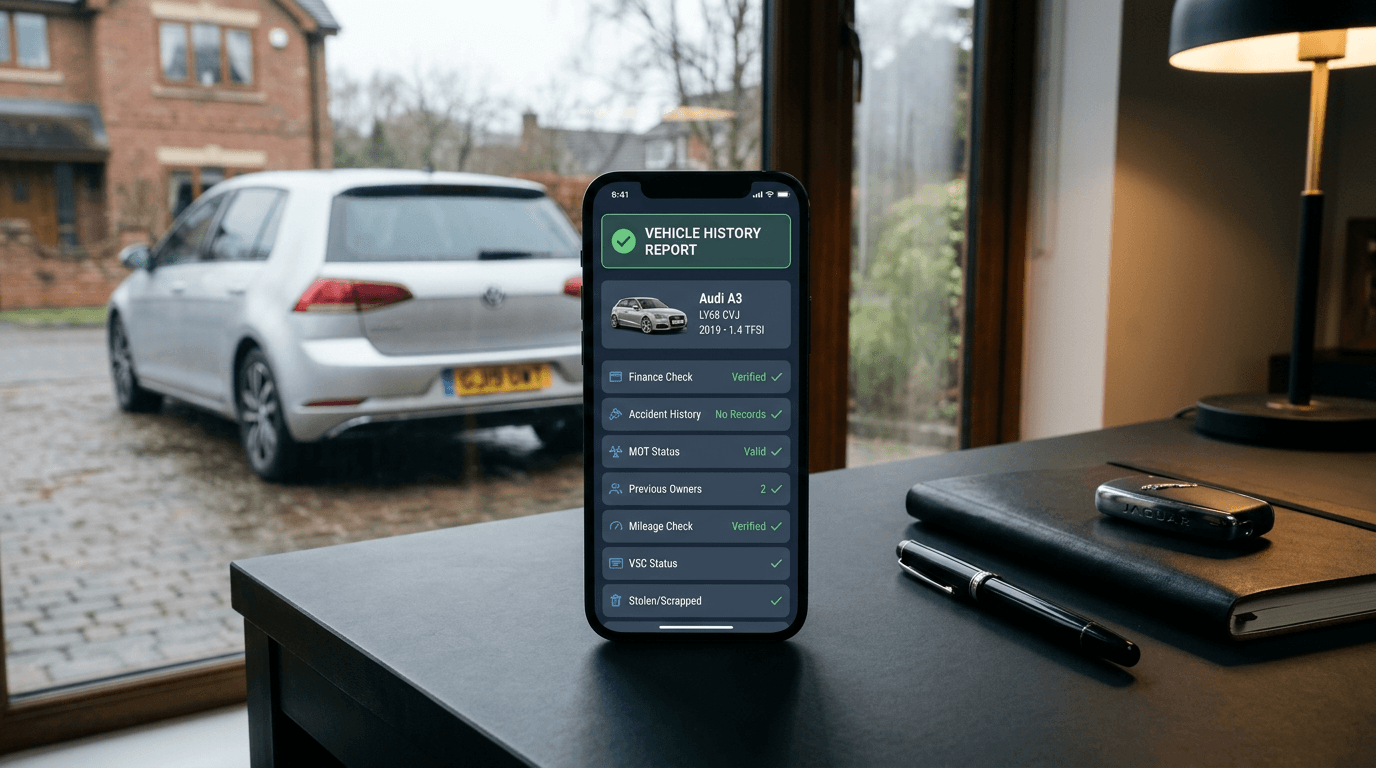
A vehicle history check reads records, not metal. It will tell you a car carries outstanding finance, a write-off marker or a mileage trail that does not add up. It will not tell you the clutch is on its way out, that the service book was stamped by the seller, or that the front wing was straightened in a friend's garage after a bump nobody ever claimed for.
Quick answer
A history check covers the paper trail attached to a registration. A physical inspection covers the car in front of you. Neither replaces the other, and the mistakes buyers regret most sit in whichever half they skipped.
What only the records show
- Outstanding finance on HP, PCP or conditional sale
- Write-off markers, including Cat A, B, S and N and the legacy C and D
- Police stolen markers
- Mileage recorded at every MOT, and any discrepancy in the trail
- Keeper history and the dates keepers changed
- Plate transfers and colour changes
- Import, export and scrapped markers
- Tax status and the recorded specification
What no record can show
- Mechanical and structural condition
- Damage repaired without an insurance claim
- Service history and cambelt intervals
- Whether a past repair was done properly
- Whether the car is insured today
- Whether recall work has been done on this car
- Anything that happened before a UK import
Start with what only the records can tell you
Finance is the one that takes the car away. On hire purchase, PCP or conditional sale the lender owns the vehicle until the agreement is settled. Buy privately from someone who has not settled it and the finance company can recover the car from your driveway, leaving you out of pocket and chasing a seller who has moved on. Nothing about the car itself gives this away, which is the entire reason a finance check exists.
Write-off markers stay attached to the vehicle long after the repair is finished. A car rebuilt to a high standard after a Cat N claim can look immaculate and still be worth noticeably less than the same car with nothing behind it. Cat S and Cat N replaced Cat C and Cat D in October 2017, so older records still carry the legacy letters.
The mileage trail is the quiet one. Every MOT records a reading, so the records build a line across the car's life. Clocking shows up as a reading that goes backwards, or a jump that ordinary use does not explain. A clean mileage trail is not proof of honesty, because a car can be clocked between tests, but a broken one is close to proof of a problem.
Add keeper history, plate transfers, colour changes and stolen and scrapped markers, and you have a picture no amount of time on a driveway with a torch would ever give you.
What a history check cannot see
Mechanical and structural condition
There is no data feed for a slipping gearbox, a weeping head gasket or a corroded rear subframe. The closest the records get is MOT history, and advisories are a snapshot taken by one tester with limited time on a ramp. Useful, not diagnostic. It is free at the GOV.UK MOT history service and worth reading for patterns rather than single lines.
Damage where nobody claimed
This is the biggest gap and the least understood. Write-off markers exist because an insurer decided a vehicle was a total loss and recorded it. If the owner paid for the repair in cash, if the work went through a trade arrangement, or if the damage was never repaired at all, no marker is created. A clean write-off result means no insurer wrote the car off. It does not mean the car has never been hit. Paint depth readings, panel gaps, mismatched shades in daylight and fresh underseal in odd places do that job, along with the usual red flags.
Service history
No national servicing database exists. Cambelt changes, oil intervals, DPF work and gearbox fluid never appear in a history check. You are relying on invoices, stamps and, on newer cars, the manufacturer's own digital record. Invoices from named garages beat a book of stamps, because stamps are easy to obtain and hard to verify.
Whether a repair was done properly
A check tells you a car carries a Cat S or Cat N marker and usually when it was recorded. It cannot tell you who did the work, whether the structure was pulled straight, whether genuine airbags went back in, or how the car would behave in a second impact. A write-off check tells you what to ask about. An inspector on a ramp answers it.
Current insurance status
The report shows tax status from DVLA records. It does not show whether the vehicle is insured today, because that sits on the Motor Insurance Database. You can check your own vehicle free at askMID.
Outstanding safety recalls
The report lists DVSA safety recalls that may affect the car's model, but not whether the work has been done on this car. That is free to check by registration on GOV.UK, and worth two minutes before you buy. An unfixed recall is somebody else's outstanding job that quietly becomes yours.
Life before the import
An import marker tells you the car came from abroad. It does not carry the history it had there. Mileage before UK registration is not in the MOT trail, and damage recorded on a foreign register does not cross over. Cars from Japan, Ireland or the EU need paperwork from the country of origin, or you accept that a chunk of the car's life is a blank page.
Where buyers get caught out
"A clean history check means the records are clean. It does not mean the car is."
- Treating clean as sound: a clear result removes the legal and financial landmines. It says nothing about the timing chain.
- Accepting the seller's check: a printout or screenshot proves nothing about the car in front of you. It can be old, edited or run against a different plate. Run your own, then match the VIN on the report to the VIN stamped on the car.
- Reading only the headline: the summary line at the top is the least interesting part. The mileage trail, the keeper dates and the pattern of advisories are where the story sits.
- Assuming a fresh MOT means a healthy car: an MOT is a minimum standard on the day of the test, and a car can pass on Monday and need serious work by the weekend.
Do both, in this order
The check and the inspection answer different questions, so do both and do the cheap one first. A car history check costs £15 and takes a minute, and it can end the conversation before you spend an afternoon and a tank of fuel driving to see a car with a lender's name on it. The inspection comes second, once the records have earned the trip.
The order tells you something about the seller too. Anyone happy for you to run the plate and read the VIN off the screen is behaving normally. Anyone who will not give you the registration before you arrive has already answered a question.
Key takeaways
- A history check covers records. Condition, service history and repair quality are not records.
- Unclaimed accident damage leaves no marker, so a clear write-off result is not proof the car was never damaged.
- Insurance status, whether recall work has been done and pre-import history sit outside the report, and the first two are free to check elsewhere.
- Finance, write-off, stolen and scrapped markers, the MOT mileage trail and keeper history cannot be found by looking at the car.
- Run the £15 check first, then inspect. They answer different questions and a careful buyer needs both.