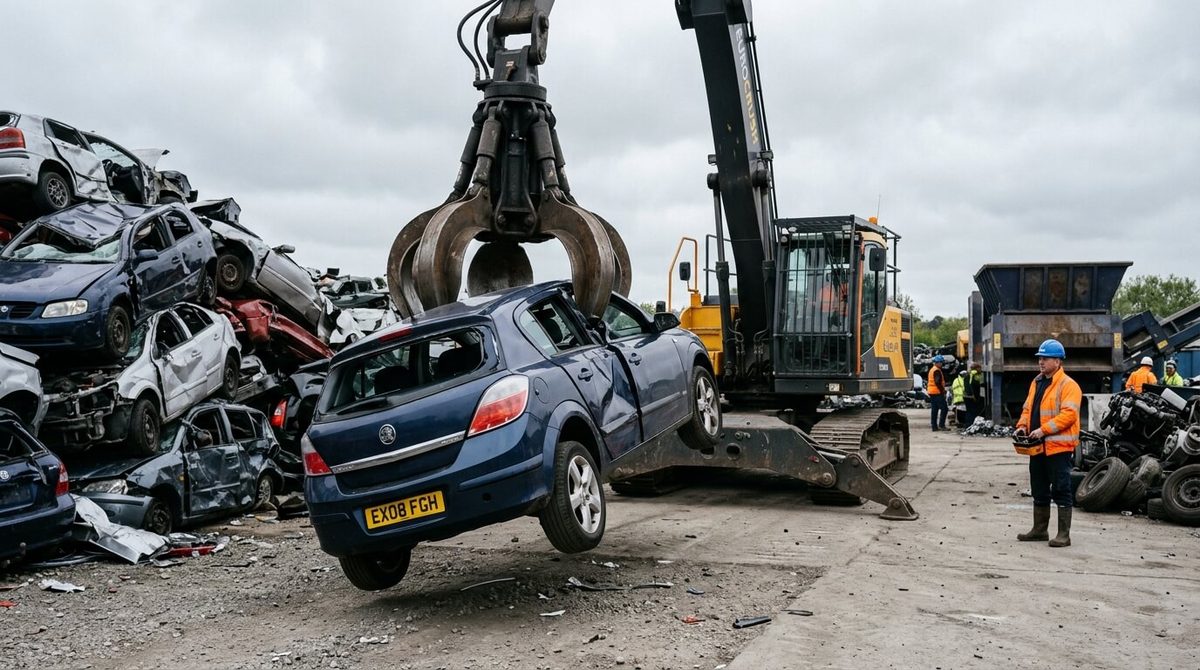
If your car is written off while it is still on finance, the insurer pays out the market value of the car and that money goes to the finance company first, not to you. The lender owns the vehicle under hire purchase and PCP, so it has the first claim on any settlement. If the payout clears the outstanding balance you keep the difference. If it does not, the shortfall is still a debt you owe.
Quick answer
The insurer values the car as it was immediately before the accident, applies whatever the policy allows, and settles with the finance company. The agreement then closes. Anything left owing after the payout remains yours to pay, and on a PCP taken with a small deposit that gap can appear surprisingly early. GAP insurance exists to cover exactly that difference. Afterwards the car carries a write-off marker for life, which is why a write-off check matters to whoever buys it next.
Who gets paid, and in what order
The sequence is fixed, and it explains most of the frustration people feel during a total loss claim. You are not the owner of the car in the insurer's eyes, so you are not the first person paid.
How a total loss settles on finance
- The insurer declares a total loss. Repair cost, salvage value and pre-accident value are weighed up, and a write-off category is assigned.
- The insurer contacts the finance company. It asks for a settlement figure, because the lender is the legal owner until the agreement is paid off.
- The lender is paid first, up to the amount outstanding on the agreement.
- Anything left over comes to you. If the valuation was higher than the balance, the surplus is yours.
- Anything short stays with you. The agreement ends, but the remainder becomes a debt to the finance company.
Your excess is normally deducted from the settlement, and if you were not at fault it may be recovered from the other driver's insurer later. Payments you have already made are not refunded, because they bought the use of the car for that period.
Why a shortfall is so common on a PCP
A PCP is built so that a large part of the car's value sits in the final balloon payment, deferred to the end of the term. In the first year or two the outstanding balance still includes that deferred amount while the car has already taken its steepest depreciation. Add a small deposit and interest weighted towards the early payments, and the balance can sit above what the car is actually worth.
That position is negative equity, and it is normal rather than a sign anything has gone wrong. It only becomes a problem when the agreement is forced to an early end, which is exactly what a write-off does. The same applies to long hire purchase deals with little deposit, and to any deal where negative equity from an earlier car was rolled in.
Insurers settle on market value, meaning what the car was worth just before the loss. Not what you paid, and not what the lender is owed. If the valuation looks low you can challenge it, using adverts for comparable cars at the time, your service history and the exact specification. A Carpeep report does not value cars, so that evidence has to come from live listings.
What GAP insurance actually does
GAP insurance pays the difference between the insurer's settlement and a second figure, which depends on the policy type. Finance GAP covers the difference between the settlement and the outstanding balance, so it clears the debt. Return to invoice covers the difference between the settlement and the price you paid. Vehicle replacement cover aims at the cost of an equivalent new car.
It is worth having when a shortfall would actually hurt. A large deposit, a short term or a car that holds its value all weaken the case. A long PCP with a minimal deposit on a fast depreciating car is where it earns its keep.
- It only pays after the main claim: GAP sits on top of a settled comprehensive claim, so no settlement means no payout.
- Time and mileage limits apply: most policies restrict how long after purchase they can be bought and how far the car can have travelled.
- You do not have to buy it from the dealer: rules require a pause of a day or two after the car sale before an add-on policy can be sold, so you can compare elsewhere.
- Excesses and arrears are often excluded: missed payments and charges added to the agreement are usually not covered.
What happens to the agreement afterwards
Once the settlement and any shortfall are dealt with, the agreement is closed. It does not transfer to a replacement car by itself. Any shortfall you still owe will also show up in the affordability assessment for the next one. Some lenders will roll an unpaid balance into a new agreement, which solves the immediate problem and starts the next one from a worse position.
Tell the finance company as soon as the claim is opened, not after it settles, and keep paying the monthly instalments until you are told otherwise. Missed payments during a claim can be recorded as arrears even though the car is gone. DVLA also has to be told, which the insurer usually handles when it takes the vehicle. The GOV.UK guidance on scrapped and written off vehicles sets out what happens to the V5C.
Get the figures in writing
Ask for the finance company's settlement figure and the insurer's valuation as documents, not phone calls. If there is a shortfall you want to see how it was calculated, and if you dispute the valuation later you need the original numbers.
Keeping the salvage
Some owners want to buy the damaged car back, to repair it or to break it for parts. That is possible on a Cat S or Cat N vehicle, where the insurer reduces the settlement by the salvage value and you keep the wreck. On finance the lender owns the car and has to agree, and it will normally want the agreement settled in full first.
Cat A and Cat B are different. A Cat A vehicle must be crushed entirely and nothing may be reused. A Cat B body shell must be destroyed, although salvageable parts can be sold on. Neither can return to the road, so retention for repair is not an option.
Why this matters to the next buyer
This is one of the main routes by which repaired write-offs reach the used market. A car is declared a total loss, sold as salvage, repaired well or badly by someone else, and advertised again. The category records what was decided about the damage, not the quality of the work that followed, and no database can tell you which one you are looking at.
What matters to a buyer is that the marker follows the vehicle, not the owner. It is recorded against the registration, it does not expire, it affects what the car is worth when you sell, and some insurers price it differently. Cat S and Cat N replaced Cat C and Cat D on 1 October 2017, so older cars still carry the legacy letters and those are just as permanent. Our guide to the write-off categories explains what each one covers, and the Cat S page deals with structural damage specifically.
So check both before you buy. A car that has been through a total loss claim has also been through a finance agreement that may not have been closed properly, and a finance check answers that from the registration.
Key takeaways
- The insurer settles at market value and pays the finance company first, because the lender owns the car.
- A settlement above the balance leaves you the surplus. A settlement below it leaves a shortfall that is still your debt.
- Negative equity early in a PCP is normal, and a write-off is what turns it into a bill.
- GAP insurance covers that difference, and is most useful on a long agreement with a small deposit.
- Keep paying the instalments until the lender confirms the agreement is closed.
- Salvage retention needs the lender's agreement, and is never possible on Cat A or Cat B.
- The write-off marker stays with the registration for life, so every used buyer should check for one first.