If you buy a stolen car you do not become its owner, however much you paid and however convincing the seller was. A thief never had ownership to pass on, so nothing passed to you. The car can be recovered by the person it was taken from, or by the insurer that has already paid out on it, and your only claim for the money is against the seller who sold it to you.
Quick answer
- You never owned it: the sale transferred possession, not title. The rightful owner's claim survives every resale after the theft.
- The car goes back: once the theft is confirmed, police seize the vehicle and return it to the owner or to the insurer that settled the claim.
- You are not automatically in trouble: handling stolen goods requires knowing or believing they were stolen. A buyer with a paper trail is a witness, not a suspect.
- Any loan survives: a credit agreement is between you and the lender, and it does not vanish with the car.
- Your claim is against the seller: legally strong, and usually worthless against a stranger who took cash and switched his phone off.
Why an innocent buyer still loses the car
English law runs on a principle usually quoted in Latin, nemo dat quod non habet. Nobody gives what they do not have. A thief has possession but no title, so every sale down the chain passes on the same nothing. Good faith does not fix it, and neither does paying a fair price.
The money side works differently. The Sale of Goods Act 1979 writes a condition into every sale that the seller has the right to sell the goods, and that condition applies to private sellers as well as traders. Where you bought from a trader, the Consumer Rights Act 2015 says the same thing in modern language. When the condition is broken you have received nothing of what you paid for, so you can claim the full purchase price back, not a depreciated figure.
The exceptions people get wrong
- Outstanding finance is not theft. A car on hire purchase or conditional sale belongs to the finance company, but Part III of the Hire Purchase Act 1964 protects a private buyer who buys in good faith without notice of the agreement. You keep the car and the lender pursues its own customer. Trade buyers get no such protection, and the protection is lost the moment you knew. This is why a finance check before payment matters so much.
- Market overt no longer exists. The old rule that goods bought in an open market gave the buyer good title was abolished in 1994. A car meet, a market or an auction gives you no special standing.
- Fraud is not the same as theft. Where a car was obtained by deception rather than taken, the fraudster may hold what the law calls voidable title, and a buyer in good faith who bought before that title was avoided can end up owning the car. It is narrow, it turns on dates, and it is not something to rely on.
How it usually comes to light
Almost never on the day of the sale. It surfaces when a number plate reader flags the plate, when a buying dealer runs a check on your part exchange, when an insurer runs the VIN during a claim, or when police unpick a cloning ring months later. People have lost cars they had owned for two or three years.
From there the sequence is predictable. Police seize the vehicle and recover it to a compound, and identity is confirmed from the VIN and the hidden identifiers rather than the plate. If the theft was claimed on insurance, the insurer now owns the car and takes it. You may be interviewed, and if your paperwork holds up, that is where your involvement ends.
Check before the money moves
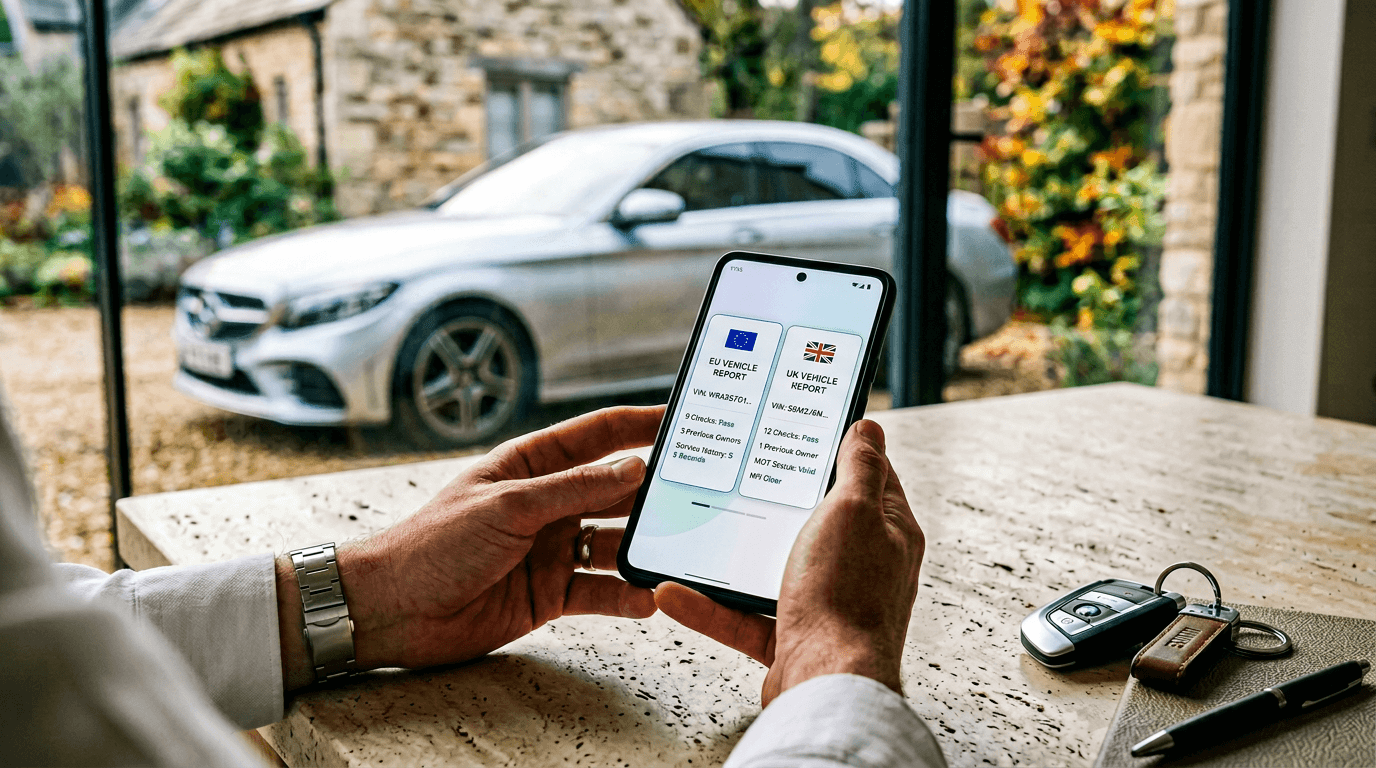
A police stolen marker sits on a national database and comes back in seconds against a registration. A stolen car check returns that marker alongside finance, write off and mileage records. Two minutes, before a transfer that cannot be undone.
One caveat worth understanding. On a cloned car the stolen marker sits against the genuine vehicle's identity, and the clone in front of you wears the same plate while carrying a different VIN underneath. That is why a VIN check against the visible plates matters, and why the guide to spotting a cloned car is worth ten minutes before you view. Our full walkthrough on checking a car is not stolen covers the physical checks on the VIN plates themselves.
Why the claim against the seller is usually worthless
You have a real right to your money back. Whether it is worth anything depends on who you bought from.
Bought from a dealer
- A registered business with a traceable address and assets.
- The Consumer Rights Act 2015 gives you a clear right to a refund of everything you paid.
- Card payments leave a route back. A credit card used for any part of a purchase over £100 and up to £30,000 brings the card issuer in alongside the seller.
- A trade association or finance provider may add another route.
Bought privately for cash
- The name on the receipt may not be the seller's real name.
- The phone is dead and the address was borrowed for the afternoon.
- Cash leaves nothing to trace and nothing to reverse.
- A judgment against someone with no assets is a piece of paper, and enforcing it costs more money.
The pattern to walk away from
Cash only, a price well under the going rate, a meeting in a car park rather than at the seller's home address, a seller whose name is not on the V5C, a V5C that is unusually crisp, and pressure to complete today. Any one can be innocent. Together they describe almost every stolen car sale.
What evidence of good faith is actually worth
It will not let you keep the car. It does two other jobs. It keeps you clearly on the right side of a handling stolen goods allegation, and it gives a claim, a chargeback or a police investigation something solid to work with.
Keep the advert with its date, every message with the seller, the name, address and phone number you were given, a photograph of the V5C, a receipt signed by both of you, the bank record of the payment, and the history check with its timestamp. Pay by bank transfer rather than cash, even privately, purely so a record exists.
If it has already happened to you
- Do not hide the car or sell it on. Passing it to another buyer once you know is a criminal act.
- Report it to the police and get a crime reference number. Report the fraud side to Action Fraud in England, Wales and Northern Ireland, or to Police Scotland if you are in Scotland.
- Tell your insurer straight away and tell any lender that financed the purchase.
- If you paid by credit card, put a Section 75 claim to the issuer. If you paid by debit card, ask your bank about a chargeback immediately, because the window is short.
- Gather your evidence into one file before messages disappear.
- If the seller can genuinely be identified, a money claim through the county court is available at GOV.UK, and Citizens Advice can talk you through whether it is worth pursuing.
One last point. The V5C that arrives in your name records you as the registered keeper. It has never been proof of ownership, and it will not protect you here.
Key takeaways
- A thief cannot pass on ownership, so an innocent buyer never becomes the owner and the car goes back to the rightful owner or their insurer.
- Your legal claim is against the seller for the full price paid, which is worth a great deal against a dealer and close to nothing against an anonymous cash seller.
- The hire purchase protection people quote covers cars with outstanding finance, not stolen cars, and market overt was abolished in 1994.
- Good faith evidence protects you from suspicion and supports a claim, but it does not let you keep the car.
- A stolen marker check takes seconds and costs a fraction of the loss. Run it before the money moves, and check the VIN as well as the plate.