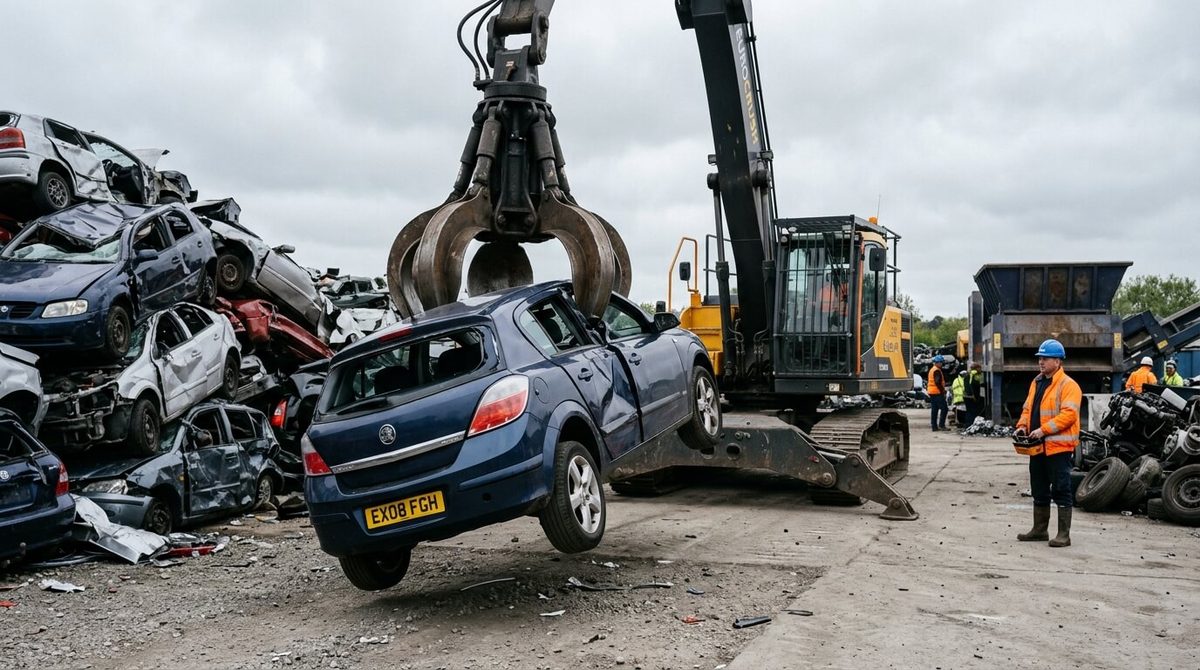
An electric car gets written off for the same reason a petrol one does. The insurer compares the estimated repair bill against what the car is worth, and when the repair gets close to the value, the car is settled as a total loss. Two things push that sum over the line sooner on an EV. The traction battery is one of the most expensive single parts on the vehicle, and damage anywhere near it triggers a cautious high-voltage inspection that only approved workshops are set up to carry out.
Quick answer
EVs are not written off because they are fragile. They are written off because the economics tip earlier. Repair estimates start higher, the battery is a large share of the car's value, fewer bodyshops hold the manufacturer approval needed to work near the pack, and used EV values have moved fast. A write-off marker is a financial decision by an insurer, not a safety verdict, and it stays on the vehicle record permanently. You can see whether a car carries one with a write-off check.
What a write-off actually is
An insurance write-off means the insurer chose not to pay for the repair. The category that follows describes the state of the vehicle, not the size of the bill. Category A and Category B cars are never allowed back on the road, so they are not the ones you meet in the classifieds. Category S means structural damage that was repairable. Category N means the recorded damage was not structural. Cat S and Cat N replaced Cat C and Cat D on 1 October 2017, so older records still carry the legacy letters. There is more detail in our guide to the write-off categories.
A category is not a damage report
Cat N covers everything from a scuffed bumper and a deployed airbag to serious electrical or water damage, because none of that is structural. The letter tells you what type of damage was recorded. It never tells you how bad it was, or how well it was put right.
Why the battery changes the maths
On most modern EVs the traction battery sits in a flat pack under the floor, between the axles. That is good for handling and cabin space, and it also puts the most expensive component in the path of side impacts, kerb strikes and anything that comes up off the road surface. A crushed sill or a damaged floor section on a petrol car is body repair work. On an EV the same area sits against a sealed high-voltage pack, and the estimate has to cover removing it, inspecting it and refitting it.
Packs are also not always replaced as a unit. Some manufacturers allow module or component level repair through their approved networks, so a pack with localised damage can be rebuilt rather than scrapped. Others treat the pack as a sealed assembly and quote a full replacement. Which of those applies to the specific car is often the deciding factor between a repair and a write-off, and it varies by make, model and age.
Inspection is cautious by design, and that costs money
After a collision an EV is not simply looked at and estimated. The high-voltage system has to be isolated safely, the pack checked for physical damage, coolant loss and insulation faults, and the diagnostic data read. Where an impact exceeds the thresholds a manufacturer sets, the procedure can call for pack replacement whether or not the damage looks dramatic from outside. Damaged EVs are often stored apart from other salvage until any thermal risk is ruled out, and storage time is cost.
The approved repairer point matters just as much. Working near a live pack needs trained technicians and manufacturer sign-off, and fewer sites hold that than hold general accident repair capability. A longer wait, a longer courtesy car bill and a specialist labour rate all sit inside the same total the insurer is comparing against the value of the car.
All of it lands on the vehicle record
None of this shows in a photograph. What does show is the marker an insurer files when it settles a total loss, and that marker is tied to the registration for the life of the car. If you are looking at a used EV, the record is where to start, before the test drive and long before any deposit.
Moving values move the threshold
The write-off decision is a ratio, so it moves when either side moves. Used EV values have shifted faster than the wider market as new models, longer ranges and changing incentives arrived. When a three or four year old EV is worth less than its owner expected, a repair bill that would once have been comfortably economic sits close to the total instead. The same damage to the same model can end differently depending on when it happened. That is also why the used market now has a steady supply of repaired EVs carrying categories, and why the price gap on them can look tempting.
"A category tells you an insurer did a sum. It does not tell you what was repaired, who repaired it, or what was inspected afterwards."
Is a Cat N electric car safe to buy?
It can be, and it can also be a car to walk away from. Cat N means the recorded damage was not structural, so the shell was not compromised. On an EV the question that follows is whether anything near the battery was involved, and what was done about it. Water ingress, a damaged charging port, a flood claim or an underbody strike can all be recorded as non-structural, and every one of them matters more on an EV than on a petrol equivalent.
Treat a categorised EV as a car that needs evidence rather than assurances. Ask what the claim was for, not just what the letter says. If the seller cannot tell you, the seller does not know.
What to ask for on a repaired EV
Evidence worth having
- The name of the bodyshop, and whether it holds manufacturer approval for high-voltage work.
- An invoice listing what was replaced, not a summary of what was sorted.
- Written confirmation that the battery pack was inspected, and what the checks found.
- Photographs of the damage taken before the repair.
- An MOT history that continues sensibly after the repair date.
Answers that should stop you
- "It was only a light knock, they wrote it off because of the age."
- No paperwork at all, or paperwork in somebody else's name.
- A repair done by a general bodyshop with no mention of the pack.
- Warning lights explained away as a software glitch.
- A price far below similar cars, with no category in the advert.
What a history check will and will not tell you
A history check shows write-off markers including Cat A, B, S and N and the legacy C and D, outstanding finance, stolen markers, the mileage recorded at every MOT, keeper history, plate and colour changes, and import or export markers. On an EV that gives you the paper trail: whether an insurer ever settled a total loss, whether the mileage pattern makes sense, and whether the car left the country and came back.
It will not tell you the state of health of the battery, it does not list outstanding recalls, and it does not include service history. Those need the car in front of you, a battery health report from a franchised dealer or an independent EV specialist, and the seller's own records. Pair the record with a physical inspection and read the MOT history for advisories on corrosion, suspension and tyres that hint at how the car has been used.
Key takeaways
- A write-off is an economic decision. It happens when the repair estimate approaches the value of the car, not when a car is beyond saving.
- The traction battery is a large share of an EV's value, so damage near it moves that sum quickly.
- Post-impact inspection is deliberately cautious, and fewer bodyshops are approved to work around a high-voltage pack.
- Falling used values lower the point at which a repair stops being economic, so more EVs cross it.
- A Cat N EV can be a fair buy with evidence of who repaired it and what was inspected. Without that evidence it is a guess.
- Check the registration for write-off markers before you view, and treat battery health as a separate job.